
What is ‘fun’ exactly?
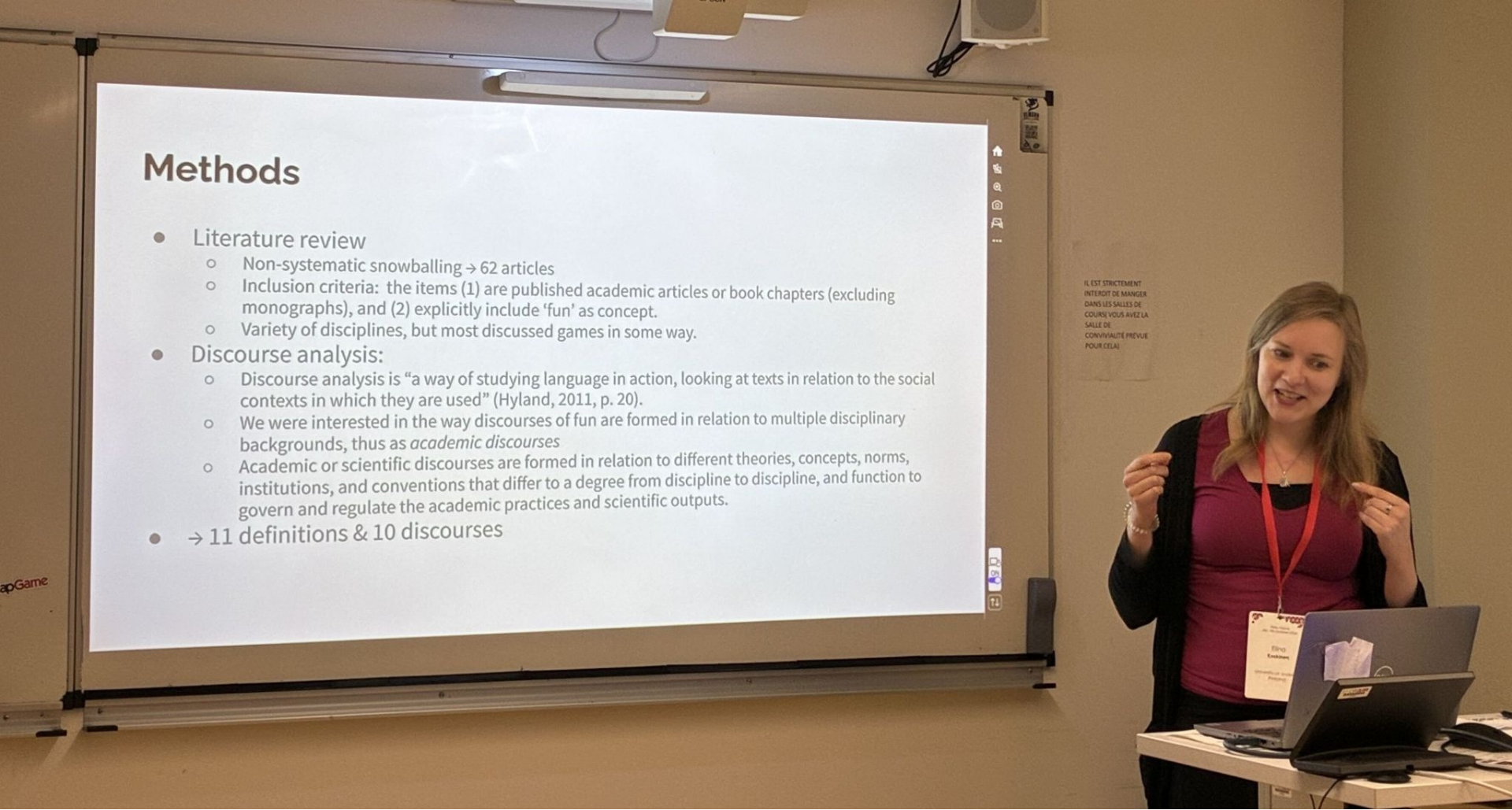
When we started the project, the first thing we wanted to learn about was how fun is dealt with within academic literature, or is it? Fortunately, with an initial snowballing literature review (see Koskinen et al. forthcoming), we were able to find some (n=62) academic articles discussing fun: we are happy to declare that ‘fun’ is indeed discussed within academia! Since we were interested in the ways in which ‘fun’ is used and perceived in academic literature, this of course was a pleasant finding.
However, while you would expect academic papers to define the concepts used in them, fun was often taken for granted: it was usually assumed that the reader knows what fun is (even in cases where fun was actually one of the variables in a quantitative study!). In our sample of 62 articles, only 11 defined the concept of fun, and some of them quite poorly.
The most explicit definitions defined fun e.g. as “grammar relation rather than specific state or feeling” meaning fun is related to “the way we use language rather than how we experience the world” (Field, 2022, p. 13), or as “an experience of liberating engagement – a temporary release from psychological restriction via a hedonically engaging activity." (Oh & Pham, 2022, p. 46), referring that fun is about hedonic engagement and a sense of liberation. So two quite different things! Meanwhile, the rest of the articles defining fun in some way described it e.g. as diversion/amusement/jocularity, as an aspect in its own right (instead of being only a mediating variable), as an evolutionary mechanism, as an emotional response, and as an outcome of difficulty. Sometimes fun was defined in a specific context, such as workplace fun, ‘fun by design’ or what is fun in telephone conferences.
Another “fun detail” was that while the 62 articles in our sample came from a variety of disciplines, most of them discussed games in one way or another, ranging from games as the main research object to being mentioned once. Only 10 of the 62 papers in the data did not mention games at all beyond the reference list.
The Discourses of Fun
While fun was not often defined very well, it was still discussed, and in many different ways and contexts. We were able to find 10 different discourses of fun:
- Fun and anxiety or negative experiences
- Understanding fun through playfulness
- Hedonic engagement for positive psychological outcomes
- Fun as emotion
- Fun as a flow experience
- Fun as a design feature
- Understanding fun through motivation
- Meaningful and eudaimonic fun
- Fun in a social context
- Work vs. play / serious vs. fun
The identified discourses positioned fun overall in a positive light, highlighting in one way or another fun’s enjoyability. However, the discourse of Fun and anxiety or negative experiences addressed the incorporation of negative experiences, such as anxiety and discomfort, in fun. “Negative fun” involving anxiety is experienced in the context of a playful scenario, which could, for example, invite the player to misbehave. The discourse of Understanding fun through Playfulness connects fun and play, yet “fun and play are not necessarily the same thing, as you can play, and not have fun” (Crawford & Brock, 2024, p. 4).
The discourse of Hedonic engagement for positive psychological outcomes described how fun entangles with hedonic engagements, for example, in gameplay experiences. Such experiences were also associated with increased happiness and psychological wellbeing. The discourse of Fun as an emotion included discussions of fun as an emotional experience. In the discourse of Fun as a flow experience Csikszentmihalyi’s flow theory was connected to fun, for example, by discussing the type of “shallow” flow that relates to psychological engagement.
The discourse of Fun as a design feature was prominent in the literature sample, since many of the articles addressed fun as an element involved both in the design process or in the designed products. Fun was also discussed as a concept that enriches the common usability criteria for evaluating designs. The discourse of Understanding fun through motivation is nicely condensed by Carroll and Thomas (1988, p. 2): “Experiences that are fun are more attractive to people of course, but fun is also likely to have powerful influences on what people will even try to do and on how long they will persist.”
The discourse of Meaningful and eudaimonic fun concentrates on the type of fun that incorporates some sort of meaningfulness that goes beyond the imminent hedonic gratification. The discourse of Fun in a social context included aspects such as the humorous nature of fun, fun being “often experienced in situations in which the person feels connected with others” (Oh & Pham, 2022, p. 55) or the statement that fun depends on the context, since adult fun is more allowed in some situations over others. Lastly, the discourse of Work vs. play / serious vs. fun recognizes how in certain cultural contexts fun has historically been set against anything that is considered serious.
Fun Works in Many (Mysterious) Ways
Based on our analysis, fun does not have one set meaning but rather is assigned to many different, sometimes even opposing positions. In general, something that could have maybe been described as ‘fun’, might have been discussed with other concepts, such as enjoyment, pleasure, engagement or motivation. The extent of how much the definitions of fun vary from each other suggests that there is a lack of scientific consensus of what fun is, and implies different possibilities of how fun can be used in scientific literature.
So, we are happy to start this project with the knowledge that fun is indeed a concept used in academia, but there is still plenty of work to do around it.
References:
Carroll, J. M., & Thomas, J. C. (1988). Fun. ACM SIGCHI Bulletin, 19(3), 21–24.
Crawford, G., & Brock, T. (2024). Just Fun and Games? A Sociological Consideration of Fun in Video Games. Games and Culture, 15554120241254876. https://doi.org/10.1177/15554120241254876
Field, G. (2022). Is Fun A Matter of Grammar? Journal of the Philosophy of Games, 4(1). https://doi.org/10.5617/jpg.9438
Koskinen, E., Ruotsalainen, M., Tuuri, K., & Vahlo, J. (forthcoming). Fun in Games and Beyond: Exploring Term Definitions and Discourses in Literature
Oh, T. T., & Pham, M. T. (2022). A Liberating-Engagement Theory of Consumer Fun. Journal of Consumer Research, 49(1), 46–73. https://doi.org/10.1093/jcr/ucab051
